Field engineer reviewing operational data on a tablet at an instrumented well site

R-COM

Governed AI for regulated oil & gas operations

Provenance, policy controls, and human approval gates for every AI-assisted action — so teams can use AI without losing control.

The gap

Rawoutput.Nocontrol.

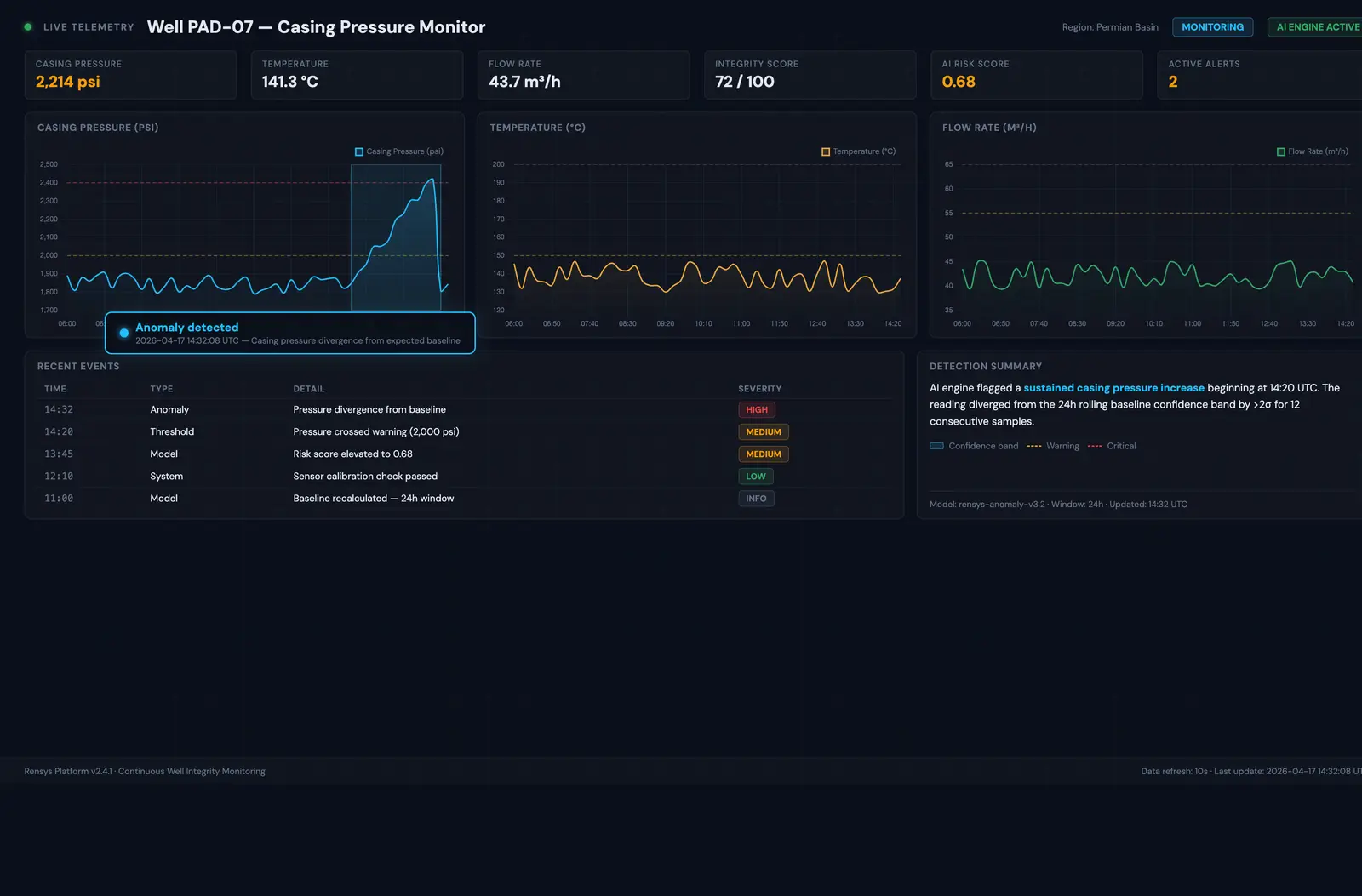
Raw AI output is not enough for regulated operations. See how Argus detects the anomalies R-COM governs.

  • AI outputs land without provenance or an audit trail teams can defend.
  • High-risk actions are handled ad hoc, without policy gates or human sign-off.
  • Review and evidence work stays scattered when regulators ask for proof.

Governed execution

Automation where it's safe. Approval where it matters.

R‑COM moves routine work forward under defined policy. When an action could affect operations, compliance, or an external submission, it pauses for a named operator/personnel decision.

R-COM control schematic

Same diagram language as The Argus Layer — policy first, human gate when risk appears, record after.

Governed action inputs

Scoped request
Permitted inputs
Role limits
Operational context

Policy-scoped automation

Routine work moves forward under defined rules — no open-ended agency

Policy engine
Permission bounds
Provenance capture
Approval required

Human decision gate

High-risk, regulated, or externally reportable actions pause here for named operator/personnel

Named approver
Explicit sign-off
Approved

Action released

Decision, supporting record, and resulting action written to the trail

Recorded outcome

Immutable audit write

Needs changes

Returned to request

Reviewer feedback loops back to the scoped request — no silent override

↺ Scoped request

Through the gatenamed approval, time-stamped provenance, immutable audit trail

Needs changesreturns to the request with reviewer feedback; no external submission

Policy-scoped permissions · Named approval · Time-stamped provenance · Immutable audit trail

Named operator/personnel. A real person owns the decision. Consequential actions pause for an accountable operations or compliance owner — not an anonymous system pass.
Consequential pause. Automation stops where risk starts. Routine work moves under policy. High-risk, regulated, or externally reportable steps wait for explicit approval.
Immutable trail. Decision and provenance stay linked. The approved version, reviewer decision, and source record remain on one audit trail for review.

Use cases

What teams use R-COM for

Governed AI workflows — each one paired with the specific control that matters most for that workflow, backed by one immutable audit trail across all three.

Well integrity operations supporting governed reporting outputs

Compliance

Reporting support

Draft reporting outputs from governed data and keep linked records for review.

Provenance and evidence

Immutable audit trail

Actions, approvals, and outputs recorded once across every workflow.

Compare approaches

From operational signal to approved, audit-ready action.

R-COM gives regulated operations teams a governed path from fragmented data and emerging risk to prioritised investigation, human approval and defensible evidence—without replacing the systems already in place.

Governed path

  1. 01Signal or document
  2. 02Risk assessment
  3. 03Recommended action
  4. 04Human approval
  5. 05Evidence pack

R-COM

Unifies operational and compliance context

  • Manual

    Fragmented across email, spreadsheets and documents

  • Point tools

    Usually limited to a single signal or data domain

  • AI copilots

    Chat context without an operational system of record

  • Connects signals, documents and decision context in one governed workflow

Risk assessment and prioritisation

  • Manual

    Ad hoc triage driven by individual judgement and shift workload

  • Point tools

    Threshold alerts without cross-domain risk ranking

  • AI copilots

    Unstructured suggestions without policy-tied prioritisation

  • Prioritises investigation from operational risk signals

Recommended action with decision provenance

  • Manual

    Actions tracked inconsistently, if at all

  • Point tools

    Acknowledge-and-close loops; limited action guidance

  • AI copilots

    Freeform recommendations without durable provenance

  • Recommended actions linked to source context and decision provenance

Human approval for material decisions

  • Manual

    Informal email, verbal or spreadsheet sign-off

  • Point tools

    Rarely includes formal approval gates

  • AI copilots

    Often framed for speed over accountable review

  • Human approval required for material decisions

Controlled escalation

  • Manual

    Escalation paths vary by person, site and shift

  • Point tools

    Alert routing without governed escalation workflow

  • AI copilots

    No controlled escalation model

  • Controlled escalation with accountable owners

Audit-ready evidence generation

  • Manual

    Evidence assembled after the fact

  • Point tools

    Logs exist; compliance packs remain separate work

  • AI copilots

    Conversation history is not audit-ready evidence

  • Audit-ready evidence packs produced through the workflow

Fit with existing operational systems

  • Manual

    Parallel work outside core systems

  • Point tools

    Point-tool silos alongside SCADA and historians

  • AI copilots

    Sits beside systems with weak operational binding

  • Layer on existing systems via API, CSV or lightweight gateway—not rip-and-replace

Deployment posture for regulated pilots

  • Manual

    Human execution outside a governed record

  • Point tools

    Monitoring-focused; limited decision governance

  • AI copilots

    Often positioned toward autonomous action

  • Read-only, approval-gated pilot—does not write to live control systems

R-COM turns fragmented operational signals into governed, human-approved, audit-ready compliance action.

Built for operators, EHS leaders, integrity teams and asset owners who need evidence-first compliance workflows—without replacing SCADA, historians or the systems already in place.

Model-independent governance

Governance that stays consistent as models evolve

Your policies, approvals, and audit trail should not need to change every time the underlying model changes.

R-COM keeps the governance layer consistent across model updates and vendor changes, so operational controls remain stable over time.

  1. 01

    Now

    Current model

    The model in use in production — policies and approvals apply the same way.

  2. 02

    Next

    Alternative model

    When you change the underlying model, governance and records carry forward.

  3. 03

    Later

    Future model

    As capabilities evolve, your audit trail and operational controls stay consistent.

Rensys governance layer — always consistent

Policies · Approvals · Provenance · Audit trail

NEXT STEP

4

Governed action steps

1

Audit trail across workflows

24h

Typical reply time

See governed AI in your workflows

Request a walkthrough of provenance, approval gates, and the audit trail — using a concrete compliance scenario before you commit to a pilot.

What we walk through

  • Human approval gate on a live draft
  • Provenance bundle and linked sources
  • Immutable audit trail end to end