
Operations
See what needs attention
Rensys brings relevant telemetry and context together so teams investigate the signals that matter—without adding another undifferentiated alert stream.

The problem
Critical events are found too late to prevent risk.
Our solution
The Integrity Layer for Critical Wells and Fields.
From Missed Leaks to Documented, Early Action.
The Argus Layer — value on day one
Standalone operator insight from Argus. Optional R-COM when you need signed, audit-ready evidence.
Data sources
The Argus Layer
Monitoring pillar — detects, predicts, and advises
Operator View
Base Argus output — no R-COM required
R-COM
Rensys Compliance
Signed Evidence Pack
Defensible record for regulators
Direct to operators — predictive alerts, live well status & maintenance guidance
Through R-COM — signed, audit-ready evidence for regulators
01OPERATIONAL SEQUENCE
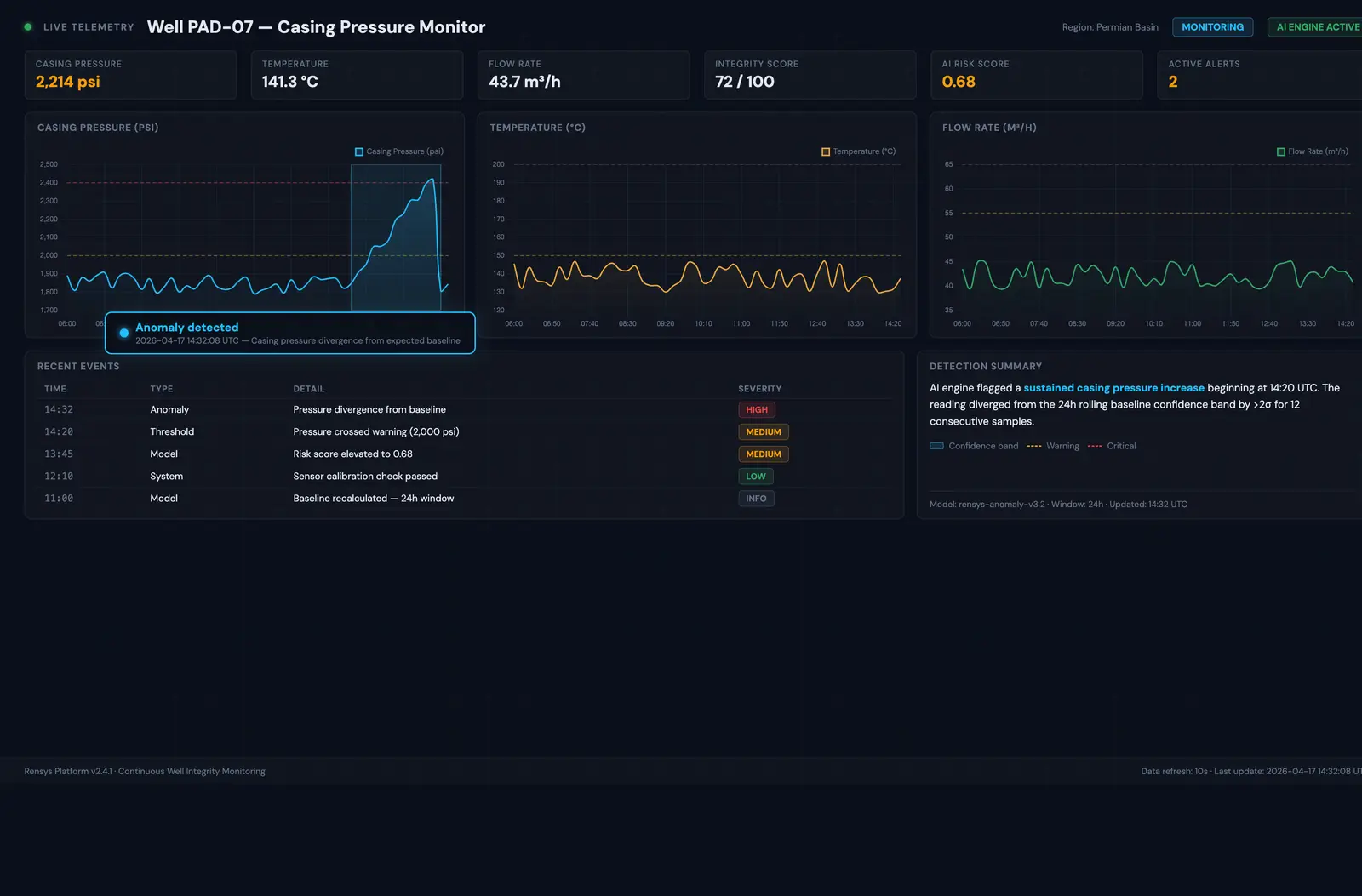
Live well telemetry is monitored continuously. When pressure, temperature, or flow diverges from expected baselines, the system surfaces the anomaly with operational context — before threshold breach.
02OPERATIONAL SEQUENCE
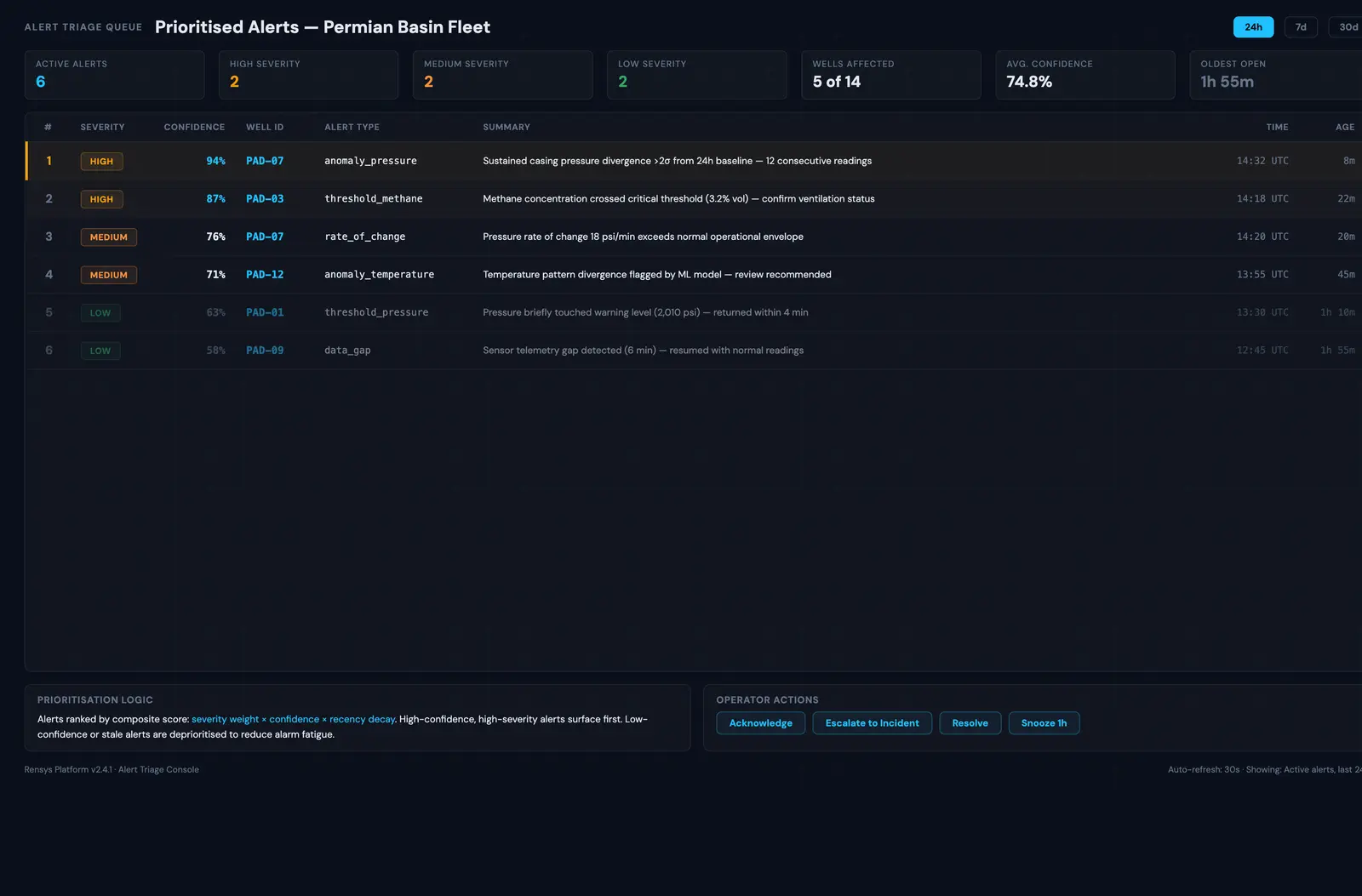
Signals are ranked by severity, confidence, and operational impact so operators see what matters first — not a flood of undifferentiated alarms.
03OPERATIONAL SEQUENCE
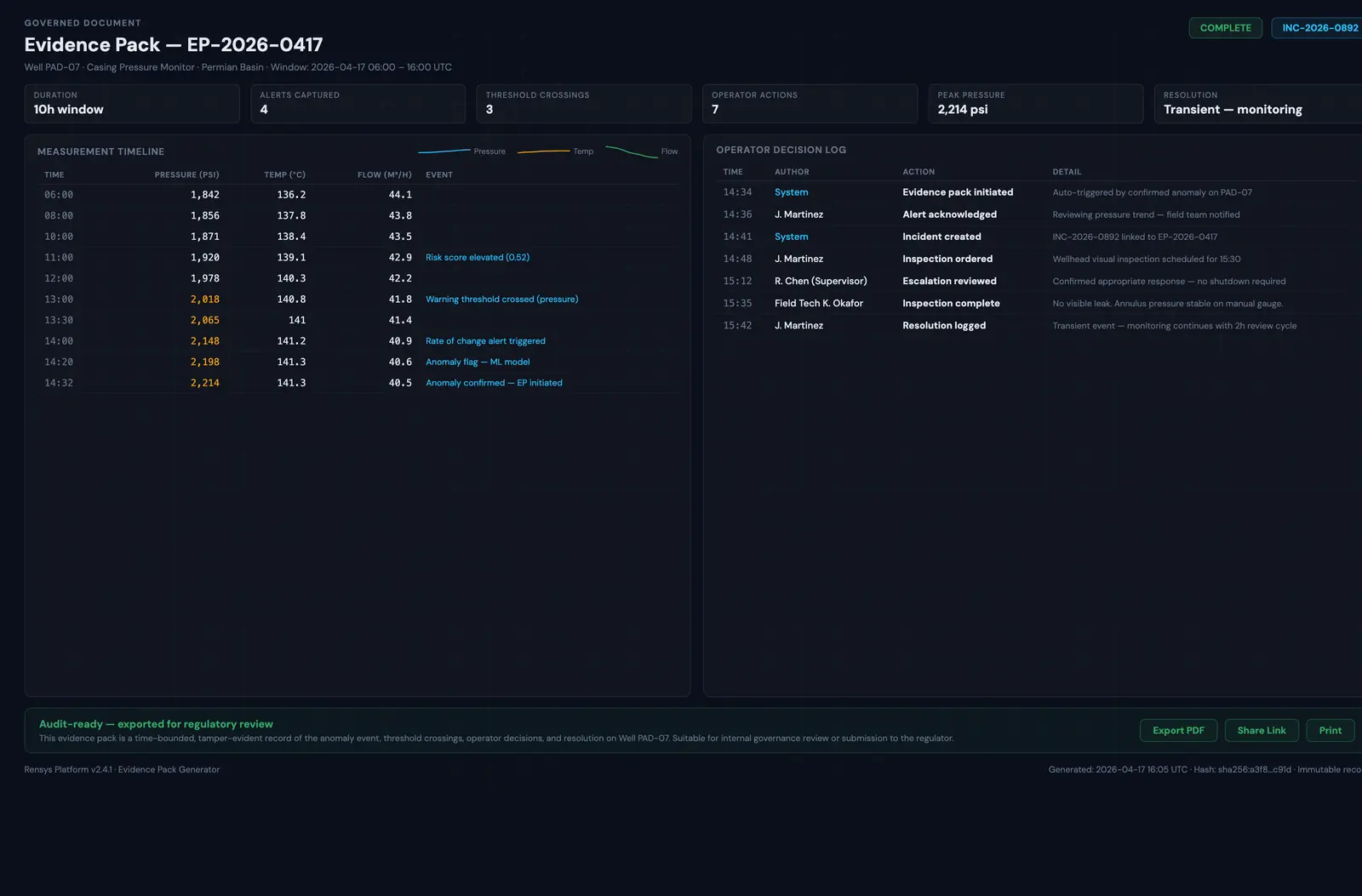
A time-bounded evidence pack assembles readings, detections, and operator actions into an audit-ready record suitable for internal review and regulatory reporting.
Connect operational data without replacing the systems your teams already rely on.
Rensys brings telemetry, inspection records and operational workflows into a governed layer for monitoring, investigation and compliance evidence—without touching live control logic.
01
Ingest data through secure APIs, structured file backfills and lightweight customer-side gateways. Rensys normalises incoming operational data into a common model, so teams can assess signals, alerts and evidence in one place.
02
Use Rensys alongside your current SCADA, historian and edge environment. Initial deployments are read-only and can be scoped around the data paths available at each asset—minimising operational disruption and avoiding a rip-and-replace programme.
03
Deploy in cloud, hybrid or local-first architectures based on site connectivity, cybersecurity requirements and data-residency constraints. Deeper platform-specific integrations are introduced only where a pilot proves the value and operational need.
04
Rensys records data lineage, system events and approval decisions to support traceability. Role-based workflows and human approvals keep high-consequence compliance and operational decisions under accountable control.
Current integration options include HTTP/API ingestion, CSV backfill and lightweight gateway patterns. Native industrial connectors are scoped against pilot requirements rather than assumed as a one-size-fits-all deployment.
Our roadmap outlines Rensys’s progression from live telemetry detection and audit-ready evidence to repeatable deployments, validated edge intelligence, and purpose-built Rensys hardware.
Pilot
01
Ingest → score → approve → evidence loop in pilot — anomaly detection and audit-ready evidence packs on live well telemetry.
Now
02Current stage
Connect existing sensors, SCADA, and historians via API, CSV, and gateway paths — no rip-and-replace required.
Next
03
One standardised, partner-sourced sensor and edge-gateway kit so deployments are repeatable, not bespoke per site.
Field
04
Paid multi-well pilots on the reference kit, measuring deployment time, detection value, and reporting efficiency.
Edge
05
Inference at the edge for low-latency, field-hardened operation — validated models on-site, not only in the cloud.
Future
06
Purpose-built Rensys sensors, drones, and wearables — only once repeatable demand, ROI, funding, and certification are met.
The outcome
Rensys turns operational signals into reviewable actions and a traceable record—without replacing the systems your teams already use.
Operations
Rensys brings relevant telemetry and context together so teams investigate the signals that matter—without adding another undifferentiated alert stream.
Operations → HSE
Each material event has a traceable path from source data to alert, review, and accountable decision—with a designated human approving consequential or reportable outcomes before they are finalised.
Compliance
For approved events, the operational record is assembled through the workflow—source extract, event and rule evaluation, time window, workflow history, approval, and artifact manifest—so teams prepare for internal review and regulatory reporting without rebuilding it from scratch.
Governed chain of evidence
Rensys does not stop at detecting or summarising an event—it preserves the governed chain of evidence from source signal to human-approved decision.
3
Evidence artifacts per pack
24/7
Continuous monitoring
1
Business day reply time
A concrete example of how Rensys packages detections, decisions, and records for review—before you commit to a pilot.
What you receive